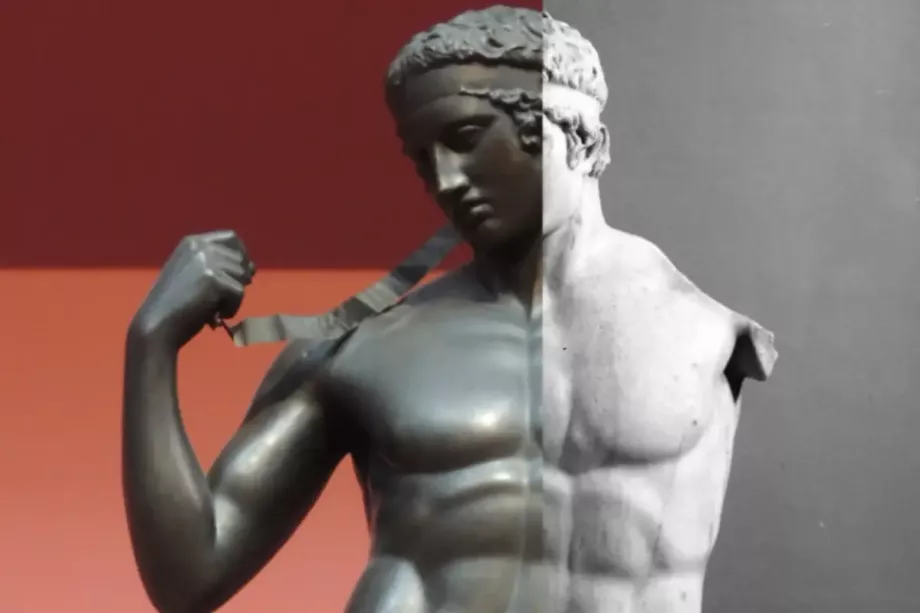
Marble sculpture is carved: the sculptor cuts the figure out of a solid block of stone, taking material away until only the form remains. Bronze sculpture is cast: the sculptor models the figure in clay or wax, and a foundry reproduces it in molten metal, an alloy of copper and tin, usually hollow. That one difference shapes everything else. Bronze is strong enough to hold an outstretched arm or a striding leg on its own and stands up to the weather, while marble is heavier and more fragile and often needs a tree trunk or strut to carry its weight. In return, marble takes a polish and a soft, almost living glow that metal cannot give. It is also why so few ancient Greek bronzes survive: most were melted down for their metal, and we know many of them only through Roman copies in marble.
Bronze: Durable and Versatile
Bronze has been a preferred medium for centuries, combining strength with flexibility.
- Durability: Bronze resists weathering and corrosion, making it ideal for both indoor and outdoor sculptures.
- Fine Detail: The form is modelled in soft clay and wax, and the cast metal can be chased afterwards, so hair, eyelids and fingernails come out crisp.
- Aging Gracefully: Over time, bronze develops a patina that enhances its depth and character.
- A Precious Metal: Bronze could be melted and recast. That made it valuable, and it is why so few ancient bronzes survive.

How a bronze sculpture is made: the lost-wax method
Most large Greek bronzes were made by lost-wax casting, which the Greeks used for statues from around 500–480 BC. The idea is simple, even if the work is not: the sculpture is made in wax, the wax is enclosed in clay, the wax is melted out, and bronze is poured into the space it leaves.
How a bronze is cast by the lost-wax method. Drawing by the author, after the Metropolitan Museum of Art and the National Gallery of Art.
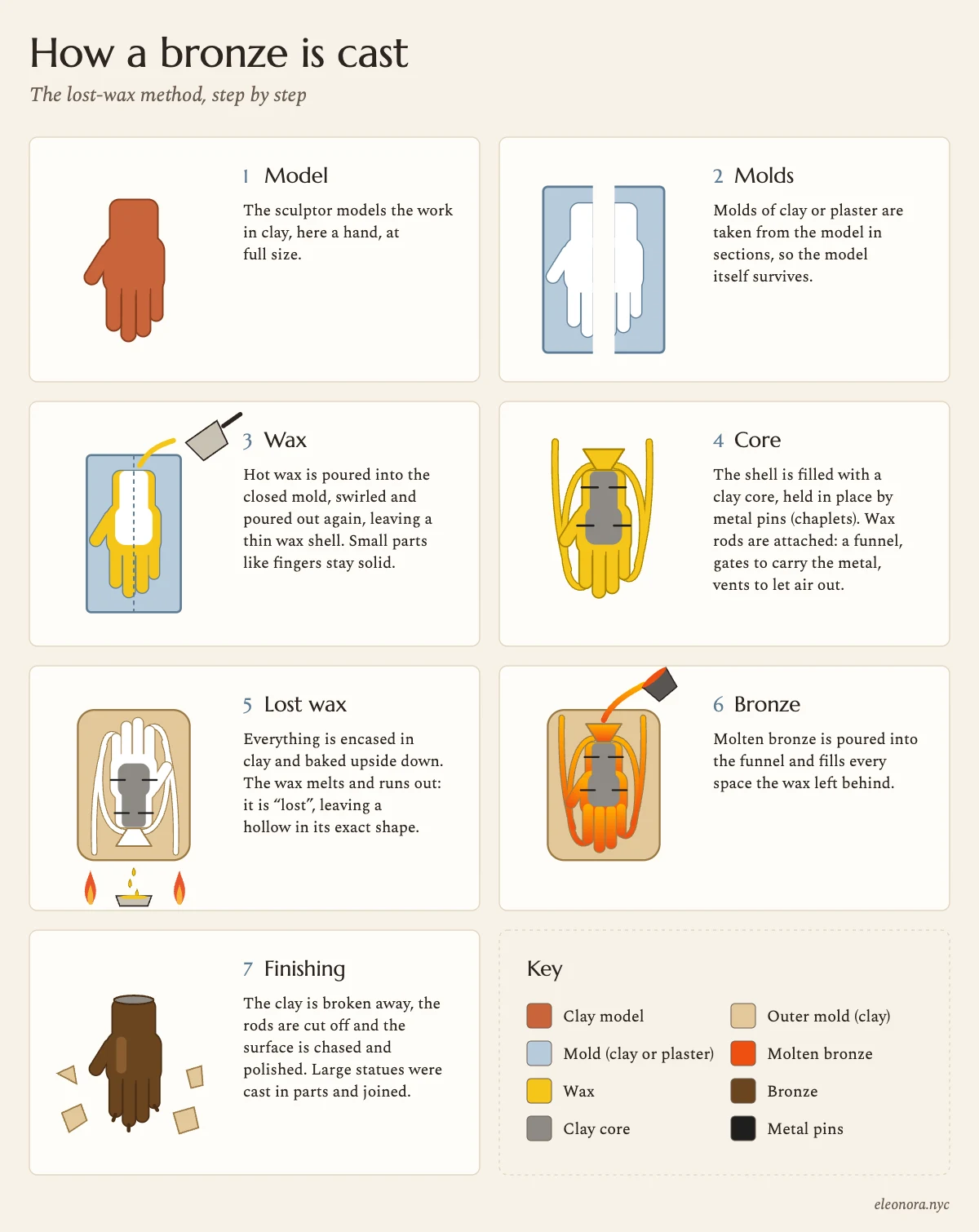
What makes the method confusing at first is that it uses two different molds. The first, of clay or plaster, is taken in sections from the sculptor’s clay model. Its only purpose is to produce a thin wax copy. The second, of clay, is packed around that wax copy and its wax channels. When it is heated, the wax runs out, and bronze is poured in its place. Because the clay model and the first molds are kept, a flawed arm could be cast again. Large statues were cast in parts (head, arms, torso, legs) and joined so skilfully that the seams can be hard to find.
Two works at the Met show both ends of the method
A small figure: the veiled dancer. This statuette of a dancer wrapped in her mantle, from the 3rd–2nd century BC, is only about 20 cm (8 in.) tall. A figure this small could be cast more directly, from wax modelled by hand over a clay core or cast solid, without master molds. The Met has not published how this one was cast, but the sharp pleats of her mantle and the sheer veil over her face show how much detail bronze could hold. I wrote about her in Ancient Greek Bronze Veiled in Mystery.
An assembled statue: the Sleeping Eros. The Sleeping Eros, 85 cm long and from the same centuries, was too large to cast at once. The Met’s technical study found that it was cast hollow in seven separate sections, using both the direct and the indirect methods, and then joined. The sections are roughly equal in size, perhaps as much metal as the foundry could pour at one time. Fragments of the clay core are still inside, and holes remain where the pins held it. Even the fine curls of his hair are solid metal, probably modelled in wax and attached separately.
What we do not know
- Whether the first molds were clay or plaster in any given case. Sources give both, because the molds themselves do not survive.
- The sculptors’ original models. They were probably clay, but none has come down to us.
- Exactly how each workshop worked. Much of the method is reconstructed from the statues themselves and from workshop remains, such as a casting pit in the Athenian Agora from about 350–325 BC, found filled with mold fragments. The waste such workshops left shows the technique kept developing from Homer’s time to Alexander’s.
- For many works, the veiled dancer among them, exactly how they were cast has not been published.
- Most of the statues themselves. Bronze was valuable, so most were melted down for their metal, and we know many only through Roman copies in marble.
Sources: The Metropolitan Museum of Art, “The Technique of Bronze Statuary in Ancient Greece” and the Sleeping Eros exhibition (2013); National Gallery of Art, “Casting Bronze Statues in Ancient Greece”; Joan R. Mertens, Greek Bronzes in the Metropolitan Museum of Art (1985).
See Greek bronzes and marbles among their contemporaries, West and East, on my art history timeline.
Marble: Timeless Elegance
Marble signifies classic beauty and artists have favored it for thousands of years.
- Refined Appearance: Marble’s smooth, polished surface conveys sophistication and grace.
- Subtle Glow: Its natural translucency interacts with light, giving sculptures a lifelike quality.
- Cultural Significance: Marble has been featured in iconic masterpieces like Michelangelo’s David and the Venus de Milo (pictured below), symbolizing tradition and artistic excellence.
- Rarity: High-quality marble is relatively rare, adding to its value and prestige.
- Delicacy: While stunning, marble is more fragile than bronze and requires careful handling to prevent damage.

Key Differences: Finding the Right Fit
The choice between bronze and marble often depends on the artist’s goals and the intended use of the sculpture.
- Expression vs. Formality: Bronze is ideal for dynamic, expressive pieces, while marble is better suited for formal, classical designs.
- Durability vs. Beauty: Bronze excels in resilience, making it perfect for outdoor installations. You best appreciate marble’s beauty in protected spaces.
- Process: Marble is carved, one block for one work. Bronze passes through the foundry, but its molds allow more than one cast.

The Takeaway
Both bronze and marble have unique characteristics that make them exceptional choices for sculpture. Bronze offers durability and versatility, while marble provides timeless beauty and refinement.
Which do you prefer for a hand sculpture; bronze's strength and flexibility or marble's classic charm?
Further Reading
The hand-detail sculpture featured in this post belongs to the renowned Torlonia Collection. You can download the Torlonia catalog here to see more of these exceptional marble works.
Join the Exploration
Culture is inherited, not manufactured. If you are interested in the fragile bridge between language, art, and the unseen, join Dreams in All Languages. I share regular reflections on the myths that shape our reality.
